GearBenalmádena
Beach equipment rental and the concession system
Apr–Oct
Every sun lounger on this coast sits inside a plot somebody had to win. Spanish beaches are public property, the town licenses seasonal services on them, and the rules that follow explain the marked squares, the fixed price boards, the buoyed channels and why one groyne bay has kit and the next one does not.
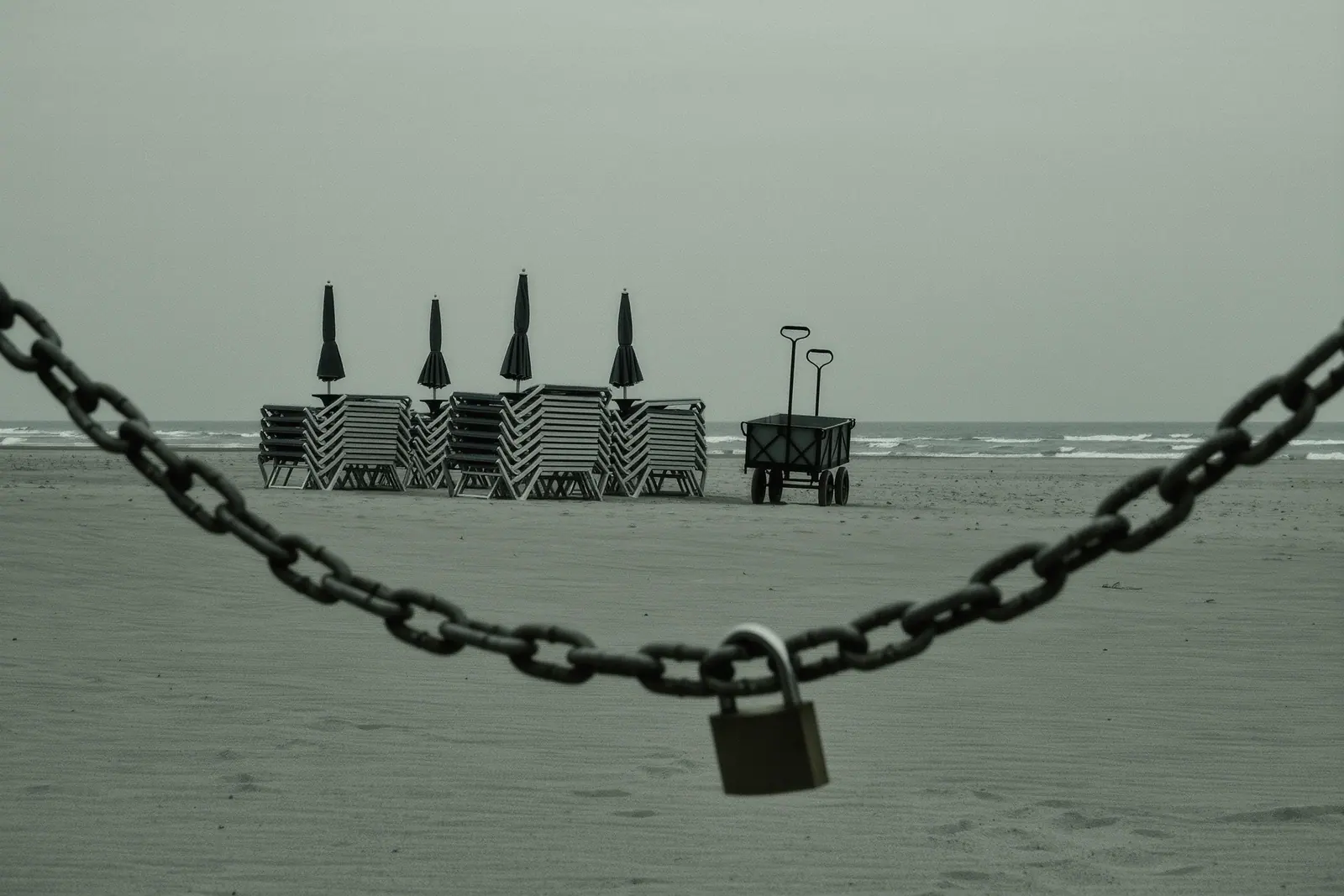
At the top of the beach at Malapesquera there is a painted line in the sand, or rather a set of small posts marking a rectangle. Inside it, rows of loungers and parasols. Outside it, towels. Nobody on either side of the line thinks about why it is there.
It is there because the beach belongs to everyone and the state says so.
The system in one paragraph
Spanish coastline is public property. Nobody owns the sand. What exists instead is a chain of permissions: the coastal authority authorises the municipality to allow seasonal services on a stretch of beach, the town divides that into plots and puts them out to tender, and the operator who wins a plot may install a defined number of loungers, parasols and, sometimes, a small building — inside the marked area, for a defined season, subject to leaving the public beach usable.
That is the whole thing. Every consequence you notice on the sand follows from it.
What the rules produce, on the ground
| What you see | Why it is like that |
|---|---|
| A marked rectangle of loungers | The concession plot; the operator may not spread beyond it |
| A price board on a post | Licensed seasonal services are expected to display rates |
| Free sand right next to paid loungers | The public beach cannot be enclosed |
| Buoyed channels through the swimming area | Craft must launch and return through marked lanes |
| Kit vanishing in October | Authorisations are seasonal, not permanent |
| One bay served, the next bare | Plots are tendered bay by bay and not all are taken |
| A walkway left through the loungers | Access to the water must be kept clear |

The Benalmádena wrinkle: groynes
This coast is defended by rock groynes running out into the water, and they cut the shoreline into a string of short bays. Between the harbour and Torremuelle you pass through several in a couple of kilometres — Malapesquera and Santa Ana on the Torremolinos side, Torrebermeja, Las Yucas and Torremuelle heading the other way.
Each bay is effectively its own beach for concession purposes, which is why the kit available changes every few hundred metres. Practical effects:
- Walk one bay along. If the loungers are all taken in front of the harbour, the next bay southwest is frequently half empty at the same hour.
- Not every bay has showers or a bar. The service comes with the plot.
- The sand differs. These beaches are replenished, and freshly delivered sand is coarser and steeper than the settled stuff. That matters more with small children than any amount of equipment.
- Shade is where the module is. There are no trees on the sand.
What is actually hired on the sand
Loungers and parasols, in sets, by the day or half day. That is the core, and after about four in the afternoon most operators drop to a half-day rate.
Beyond that, expect some or all of: pedalos, kayaks and paddleboards from a separate operator with a buoyed channel; small locker or valuables boxes at the module; sunbeds with a canopy at a higher rate; and, on the busier bays, a service that will carry things down for you. Anything you want for the whole stay rather than the afternoon — a board, a wetsuit, a rack space to keep them in — comes from a shop rather than from the sand, and that market works to different rules, described in water sports kit hire for a week. Larger family kit — cool boxes, windbreaks, beach carts, umbrellas for a whole week — is generally not a beach concession product at all. That comes from a shop, and it is covered in sun loungers, parasols and what you may bring yourself.
Wind, and the money question
The levante is the wind that closes the parasols. When it gets up in the afternoon, attendants go along the rows folding them, because a parasol in a gusting easterly is a spear. That is the correct decision and it is also the moment to have already asked what happens to your money.
Practice varies and it is not regulated in any way you can rely on. Most operators are reasonable about a half day that ended at two. Some are not. Ask before you pay, and if the sky over the sea to the east has that hard flat look in the morning, take the half-day rate rather than the full one.
What to do about it
Two habits.
First, read the board. It is there because it has to be, it shows the rates and the season, and it removes every argument that otherwise happens at the end of the afternoon.
Second, know that you can always walk away from the plot. On a busy August Sunday, paying for a lounger in the bay by the harbour is worth it. On a Wednesday in June, the free sand thirty metres to the left is identical and the walk to the water is the same. The equipment is a convenience purchase, not an entry fee, and treating it that way is the difference between a beach that costs something and a beach that costs nothing.
What to check before you book
- Look for the posted price board at the module before you sit down. Seasonal services are expected to display their rates.
- Check whether the rate quoted is per lounger, per set with a parasol, and whether it is a half day or a full day.
- Ask what happens if the wind gets up. On a levante the attendant will take the parasols down and the money question should be settled first.
- Look at where the marked plot ends. Outside it, the sand is free and nobody may move you off it.
- If you are hiring anything that floats, check it launches through a buoyed channel rather than across a swimming area.
- Verify current municipal beach rules with the ayuntamiento if you plan to bring gazebos, windbreaks or anything staked into the sand.
Questions people actually ask
- Can I be charged for sitting on the beach?
No. The sand itself is public and free, and you may put your own towel down anywhere outside a marked concession plot. What you pay for is the use of equipment — the lounger, the parasol, the service — inside an area the operator is licensed to use. If anyone suggests the beach itself costs money, they are wrong.
- Why do some beaches here have loungers and others do not?
Because the seasonal services on each stretch are put out by the town under authorisation from the coastal authority, and not every plot is taken up every year. Benalmádena's beaches are cut into small bays by groynes, so one bay may have a full module with loungers, showers and a bar while the next has bare sand.
- Are prices fixed?
Rates for licensed seasonal services are generally required to be displayed, and in practice the figures across a municipality cluster closely. Expect a lounger and parasol set to sit in a modest band that rises from spring to August, with half-day rates commonly available after about the middle of the afternoon. Read the board rather than asking.
- Can I bring my own parasol?
Generally yes, on free sand, subject to the town's beach ordinance about what may be planted, how big it may be and how far from the water. Municipal rules differ along this coast and are enforced by local police rather than by the lounger operator, so check the current ordinance if you are bringing anything more substantial than a parasol.
- When does the season run?
Broadly from Easter to the end of the summer, with the fullest service through July and August and a reduced presence at each end. Some modules stay up into October in a warm autumn; most of the kit is gone by November, when the same stretch of sand is walked by people in fleeces.